Irish ancestry through DNA
My Di’s DNA shows as 84% Scottish and 16% Irish. He knew that his gran, Mary Ann Murray was of Irish Descent and if asked he would have said that he had a little Irish in him….so without any research he wasn’t far off the truth. As Irish records are very difficult to come by and I I have use DNA to look further back in our Irish history.
We know for certain that his 8 great grandparents (Generation 7 of this story) were born in Scotland. However out of his 16 great great grandparents 4 were born in Ireland – Peter Murray, Thomas Brown, Mary Ann Devlin and William Beattie. This gives as about 25% Irish heritage – more than what I would expect according to DNA results. This raised the question if my ancestors were Irish or were they Scottish, but born on Ireland.
Understanding their Lives
In Ireland in the 18th Century people were generally very poor. They grew their own food such as oats, barley and potatoes on rented land to sustain themselves. They used simple tools such as shovels and hoes to farm, and raised and sold pigs to earn some extra money. People mainly wore clothes made out of simple materials such as wool to stay warm. People in Ireland lived in houses made of mud and stone, often cabin-like, with only one or two rooms and no windows. They weren’t anything like the houses we live in today. The only furniture people owned were chairs and beds, but often people had to sleep on the floor. The only way people could generate heat was by burning turf or cooking in a big metal pot, typically in the centre of the home to keep everyone warm. These bleak living conditions were difficult for many people.
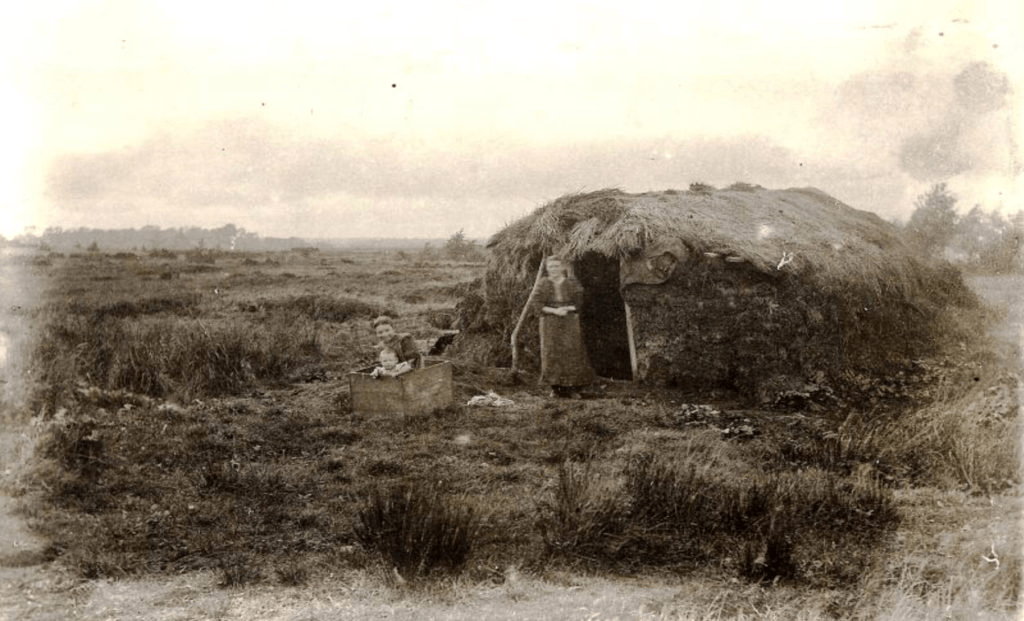
The 1841 census divided the houses of Ireland into 4 categories with 40% of all rural families in Ireland living in one-roomed cabins pictured (4th class). Entire families lived together in these tiny houses, sometimes sharing their living accommodation with a pig.
“Fourth Class families were those living in all Mud cabins having only one room; the third, a better description of cottage, still built of mud, but varying from two to four rooms with windows; the second, a good farm-house or, in towns, a house in a small street having from five to nine rooms with windows; and the first, all houses a better description than the preceding ones.” Poverty, famine, and political and religious conflict led many to migrate at this time. Some left for Scotland or Australia, but the most common destination was the United States . I believe my ancestors came to Scotland as they couldn’t afford the fare to the United States, even if they sold their worldly belongings it wouldn’t amount to enough.
From Wikipedia :-
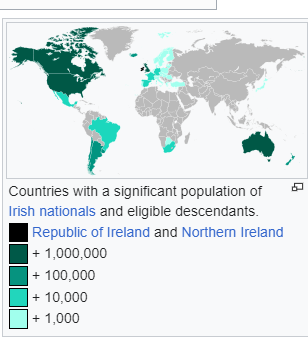
The phenomenon of migration from Ireland is recorded since the Early Middle Ages, but it can be quantified only from around 1700. Since then, between 9 and 10 million people born in Ireland have emigrated. That is more than the population of Ireland itself, which at its historical peak was 8.5 million on the eve of the Great Famine. The poorest of them went to Great Britain, especially Liverpool. Those who could afford it went further, including almost 5 million to the United States.
After 1765, emigration from Ireland became a short, relentless and efficiently managed national enterprise. In 1890, 40% of Irish-born people were living abroad.
Northern Ireland
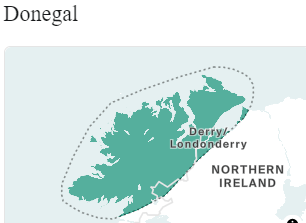
The DNA test confirms that the 16% Irish reported was all from Northern Ireland, specifically the two areas of Co. Donegal and Antrim, or Ulster depending on what time in history you lived there.
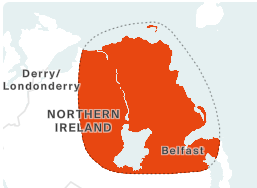
Antrim
The generation mentioned above was born almost 200 years ago in the early 1800’s. We know that Peter Murray was a Irish Traveller, Thomas Brown was Catholic, Mary Ann Devlin was from Armagh and William Beattie was from Newtownards. Both Newtownards and Armagh are in what we now call Northern Ireland. So far so good, DNA and records are matching up.
Peter Murray allegedly married Mary Flood is Scotland (I don’t have the marriage certificate to confirm this), although Mary was born in Aberdeen her parents were Irish. Her father, James, was born in Donegal and in the 1861 census he was a Hanker (pauper) in the poorhouse. The families circumstances didn’t change as the years went on as his wife, Mary Haggerty, who was also born in Ireland (Derry, Northern Ireland) was living in the poor house before she died. Mary was also a Hawker.
Peter’s parent’s were Irish, His grandparents Bernard Murray and Ann Costello were Irish Catholics and he was a Tin-Smith like his father William. They were poor, they travelled for work and although Peter’s parents survived the Famine and made it to Scotland they lived in extreme poverty.
We have no records to suggest that Thomas Brown’s parents – James Brown and Mary McIver survived the famine.
However, Mary Ann Devlin’s Father did make it to Scotland. we have his death certificate as proof of this. He also died in a poor house, his wife Mary Mullen lived to a good age and lived with her children. I do think at least one of those children returned to Northern Ireland after he death – strengthening the Irish connection.
The only other Irish link in my records is William Beattie. Beattie is from the maternal side of my Di’s tree (Rae) whereas all the names above are from the paternal side (Leitch).
Antrim
In ancient times, Antrim was inhabited by a Celtic people called the Darini. In the early Middle Ages, southern County Antrim was part of the Kingdom of Ulidia. who were pre-Gaelic Celts and probably related to the Picts of Britain. In the late 12th century Antrim became part of the Earldom of Ulster, conquered by Anglo-Norman invaders. A revival of Gaelic power followed the campaign of Edward Bruce in 1315, leaving Carrickfergus as the only significant English stronghold.
Ulster Ireland
Just thirteen miles apart at their nearest points, northeast Ireland (not far from Newtonards) and southwest Scotland have close cultural and historical ties. The first Scottish Protestants moved to the province of Ulster in the 17th century. Since then, the Ulster Scots have experienced ongoing political conflict with the native Irish Catholics.
The Plantation of Ulster was established by King James I of England and Ireland in 1609, the plantation was an organised colonisation of the Northern region of Ireland to establish political and economic control. Most of the settlers came from the Scottish Lowlands and Northern England. On 2 March 1613, James I granted a charter to “The Honourable The Irish Society” to undertake the plantation of a new county. This county was named Londonderry, a combination of London and Derry. This charter declared that the “City of Londonderry” and everything contained within the new county: shall be united, consolidated, and from hence-forth for ever be one entire County of itself, distinct and separate from all our Counties whatsoever within our Kingdom of Ireland-and from henceforth for ever be named, accounted and called, the County of Londonderry.
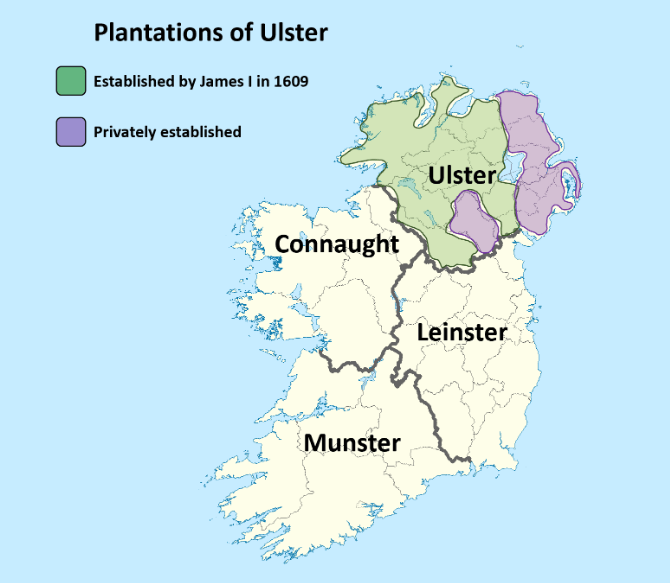
My research proves that William Beattie was a Presbyterian and from Britain and although both his parents were born in Ireland his grandparents came over from Scotland, maybe as part of Ireland Plantation of Ulster, thus decreasing the Irish link and bringing my research inline with the DNA results.
William also married Elizabeth Madden. We have already research that her father was born a British Subject in Portugal because his father was a military man born in Ireland. Due to the British subject classification and the DNA results I think we can confirm this line is British, NOT IRISH.
Catholicism
This in turns shows that my Di’s paternal link (Peter Leitch) in Ireland is Catholic whist the maternal side (Janet Rae) is Protestant and Scottish.
Catholicism came to Ireland in 4th century with the Romans. It is most famously associated with Saint Patrick but for the last several centuries, the Irish Catholic majority were suppressed. Catholicism became closely associated with Irish nationalism and resistance to English rule. This dates back to the reformation when England and Wales, and then Scotland, changed to Protestantism Ireland didn’t.
The Future
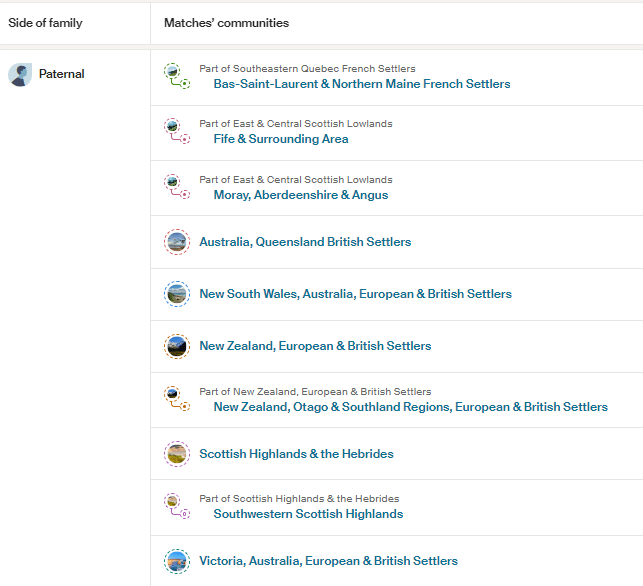
The snapshot shows some of the areas people who share my Di’s DNA – This is mainly Scotland, Australia and New Zealand …I wonder what it will look like 200 years from now
 Marie's Genealogy