10th Generation
Rattray was my Di’s middle name, His grandfather was also named Thomas Rattray Leitch. Rattray was his mother’s maiden name and it was her grandfather that was Thomas Rattray. When a name follows the generations like this is does make it more interesting, why was the name so important or was it simply the copying of names down the generations?
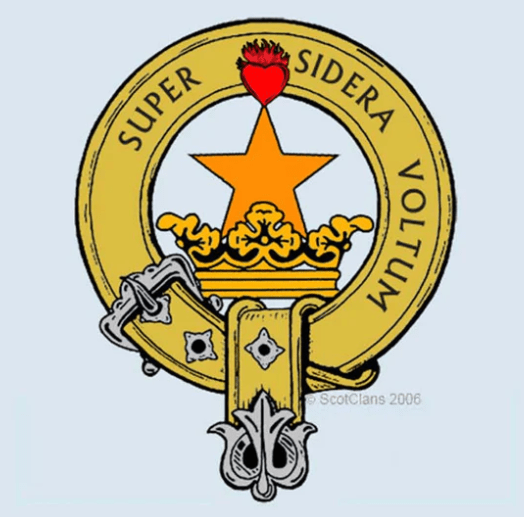
The Rattray clan motto is “Super sidera votum” (My wishes are above the stars) and the clan crest is a flaming heart atop a star.
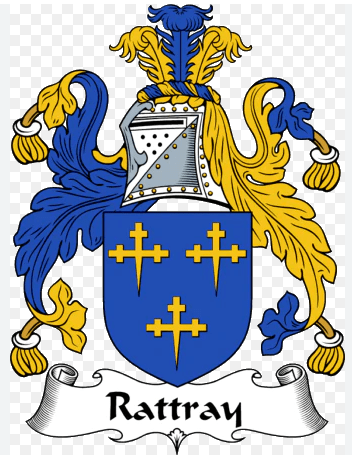
The name Rattray is taken from the barony of Rattray in Perthshire. This barony was in their possession from the 307 AD, and derived from Constantine. The Rattray estate includes the ruins of a rath-treif, a combination of Gaelic and Cymric words meaning “hill fort.” I have been unable to find a paper trail to connect me to the Rattray clan, I have however found through DNA testing a link to to Perthshire. Both my Mother and I have the DNA for Perthshire, however my maternal Grandmother does not, thus the link being through my Di.
I have tried to represent the ancestors I have spent time researching on the table below. As you will see I have struggled to find any solid information past the 1700’s.
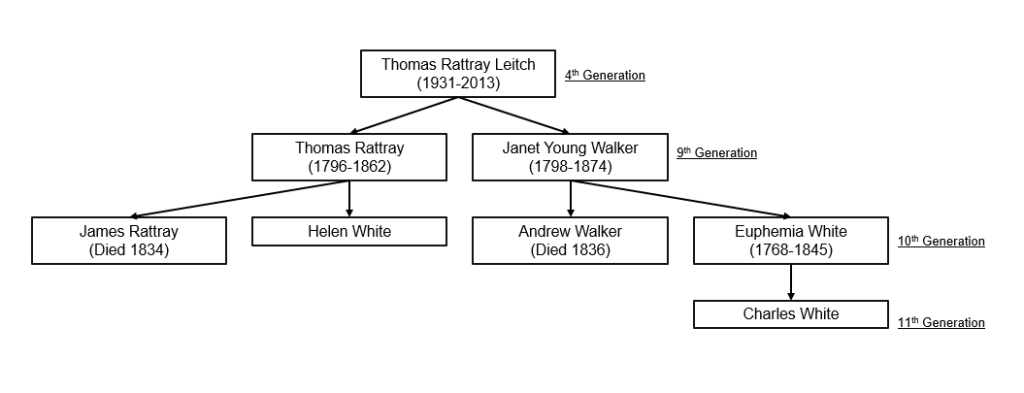
10th Generation – James Rattray & Helen White
James Rattray married Helen White on the 7th July 1793 in Dysart, I have details of their children’s life under Thomas Rattray . We know from the children’s details that James was a Collier Clerk. James’s job was administration based and he would have kept records of the coming and going of the colliery. He would not have been working in the mines and must have had good literacy skills to be given the post. We are however still in the time frame of serf’s and James would have “belonged” to the collier owner.
” The process of emancipation began with an Act of Parliament of 1775 which freed the colliers in age-groups – those under 21 and between 35 and 44 were to be freed in 7 years, those between 21 and 34 were to be freed in 10 years and those over 45 were to be freed in 3 years. The liberation of the father freed the family. However, gaining freedom required a formal legal application before a Sheriff and a great many colliers continued to be bound until 1799 when an Act was passed that all colliers in Scotland were “to be free from their servitude”.
Although I have a marriage certificate showing that James married Helen White and that she is detailed on her children’s birth certificates I can not find a birth or death certificate registered for her in the church records. This would lead me to believe they were either not religious or very poor, our both.

Unfortunately the last details I have found for James show that he was living in Abbey Park, Dunfermline (He would have moved to Dunfermline for work) and that he died on the 12th May 1834. James was buried in common ground, this was a paupers grave, he had no head stone. Due to the time frame of the emancipation and that the were “free from servitude” this could have resulted in James being a pauper at the end of his days. During this time people relied on the church for support if they were paupers.

10th Generation – Andrew Walker & Euphemia White
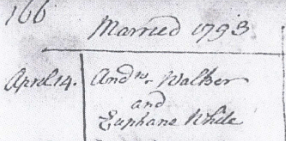
Janet Young Walker‘s parents were Andrew Walker and Euphemia White. As I did above, I know that Andrew was a Blacksmith through his children’s records. They also married in 1793, in Cupar, Fife.
Being a Blacksmith was a skilled craft in the 1800’s, blacksmiths provided important services to growing communities. Rural blacksmiths were able to work on a number of different types of smithing. The more diverse a rural blacksmith’s skill, the more valuable he was to the community.
Cupar is a royal burgh and market centre in north eastern Fife It is situated on the banks of the River Eden in the fertile valley known as the Howe of Fife. The old Parish Church dating back to 1415 was taken down and a new church erected in 1781. This may be why I’m struggling to find any records before this date. During the 13th century Cupar became the centre of the administration of justice for Fife and was became a royal burgh in 1356. It remained the administrative centre for Fife until 1975.
Andrew used his trade to travel around Scotland for work. Although he married Euphemia in Cupar, they were living in Ayr 5 years later when their daughter was born and shortly after that they moved to Aberlady, Lothian and then onto Edinburgh. However, Andrew returned to Cupar to live out his last days. I believe that you had to return to your own parish for relief when you were no longer able to provide for yourself. Andrew died on the 21st November 1836 and was buried 2 days later.
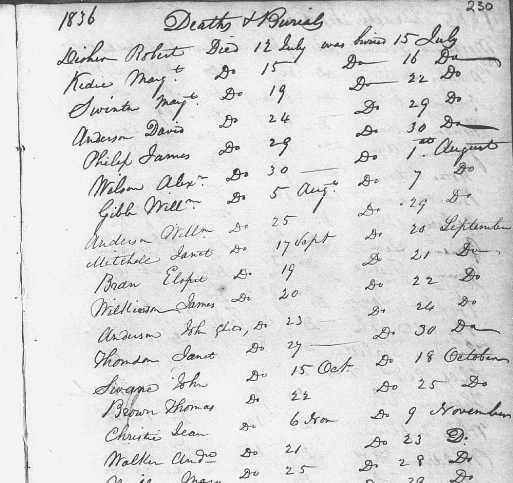
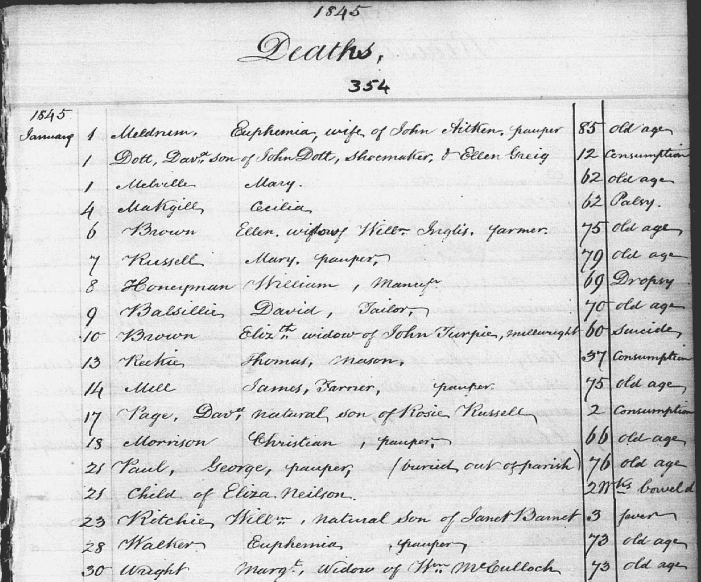
Andrew’s wife, Euphemia, died 9 years later in 1845 – she also died a pauper. This would be because she would have relied on the church for support once her husband died. I feel it is worth noting again that although a pauper is poor they may not have been poor throughout their life and only been a case of relying on the church for support in their twilight years. Today we are lucky enough to receive a pension – the working class did not have that privilege in the 1700/1800’s.
11th Generation – Charles White.
I did manage to get at least one birth certificate from the 10th Generation, Euphemia’s. Euphemia was born on the 27th December 1768 to Charles White, Land Labourer in Cupar.

There is no doubt that Charles would have had a hard life as a farm labourer. Having this certificate, the only one of the generation, shows that the owner of the farm did give him time to register his daughters birth. Considering this is over 250 years ago and administration amongst farmers would be more on their animals and crops rather the labour I will take this as a sign of a good life at the farm.
 Marie's Genealogy