10th-15th Generations
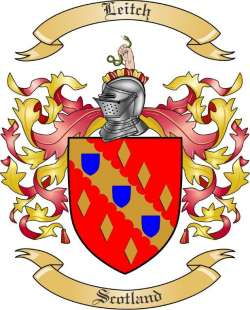
The early history of the family name Leitch is a tale of Scottish origins, clan affiliations, and migration. It first emerged as a surname in the medieval Scotland.
Through DNA testing I can confirm the records I have uncovered are a true reflection of my heritage and I am related to Andrew Leitch who was part of my 9th Generation of stories previously published. As I was lucky enough find his birth, marriage and death certificates I have been able to dig deeper into the past, starting with his parents – the 10th Generation.
I have tried to represent the ancestors I have spent time researching on the table below. As you will notice if I have kept to the parental line as much as possible to give you an insight into the name Leitch and my direct ancestors over the past 15 generations / almost 500 years.
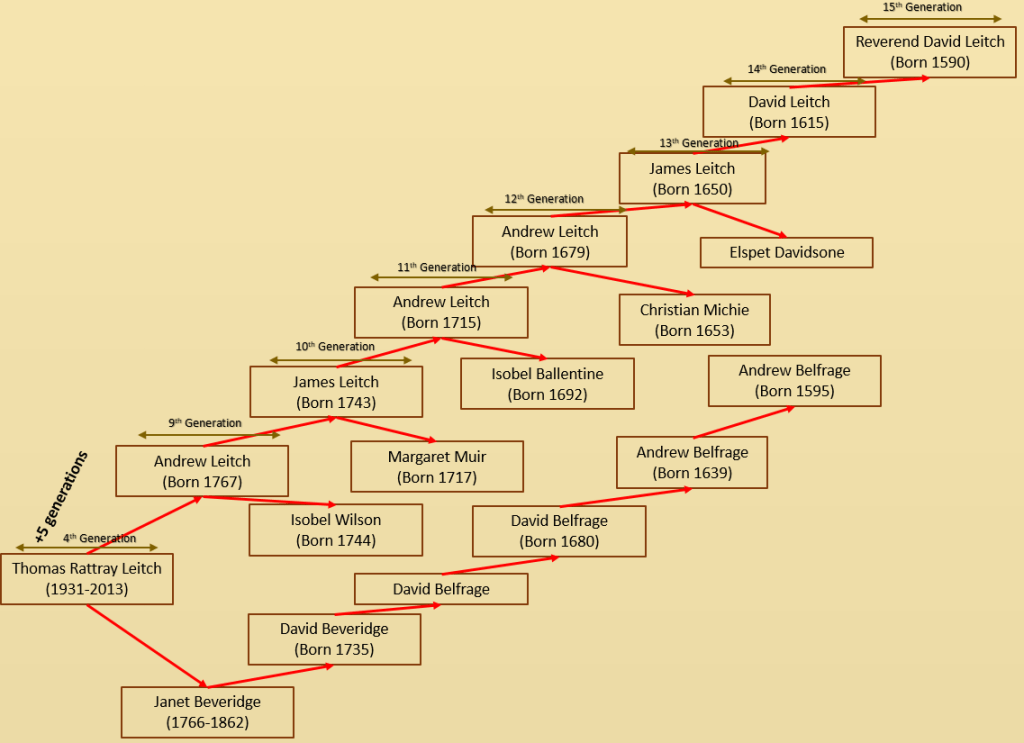
*Please note that Leitch is spelt in numerous ways below, they are not spelling mistake but the way they were spelt on official documents*
10th Generation – James Leitch & Isabel Wilson
James Leitch was baptised on the 11th September 1743 in Dunfermline Associate Church to Andrew Lietch* and Margaret Hume. The screenshot below shows that James was a twin and further sibling followed – William, Thomas, Isobel and Elspeth.
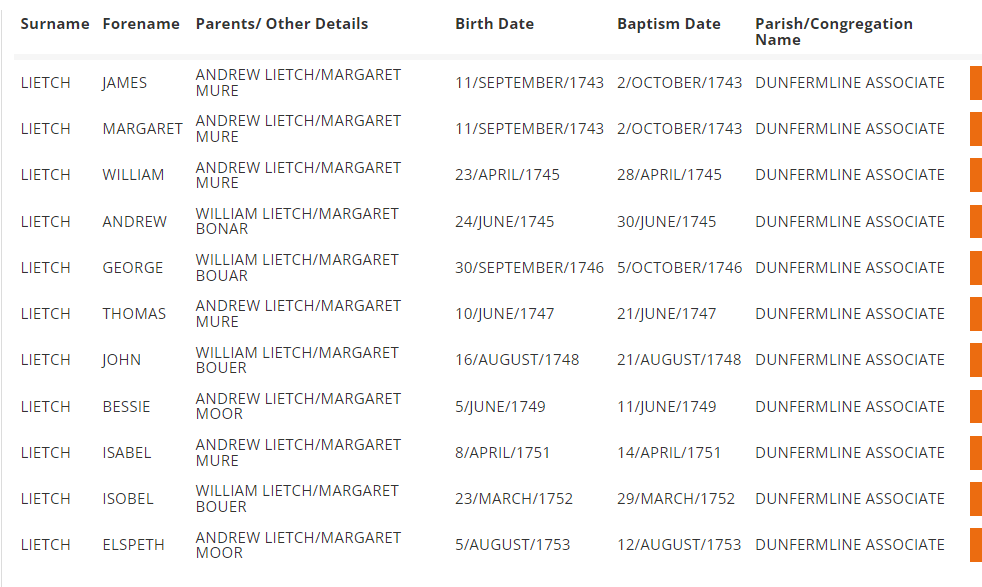
As you can also see there is a William Lietch*, in the same church, who also married a Margaret, and had children in the same 10 year span. The likelihood is this is a brother or cousin to Andrew.
On finding James birth certificate (below) we can see that the lived in Aberdour and that the William mentioned above was the witness to thw twins birth. The record below James’s birth certificate shows that both Andrew and William were the witnesses for the next child baptised in the church. I believe this shows that the Dunfermline Associate church was a close community.
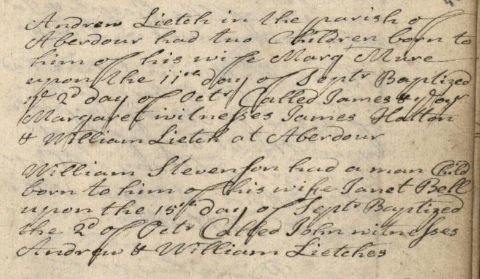
The reference to my ancestor being baptized before the Associate Congregation means that his parents had left the established Church of Scotland and joined a group known collectively as the Associate Synod – the local church would be called an Associate Congregation. This process of leaving the Church of Scotland began in 1733 and Dunfermline was one of the main centres of what is often called the Original Secession. The reason for the split was the imposition of patronage by the government in Westminster – they gave a patron, often a local landowner, the right to select the parish minister and the people who left the Church of Scotland felt strongly that the local congregation ought to be allowed to choose their own minister. My ancestors would have been willing to face the financial implications of their decision as the congregations of the new church had to find the money to pay their minister.

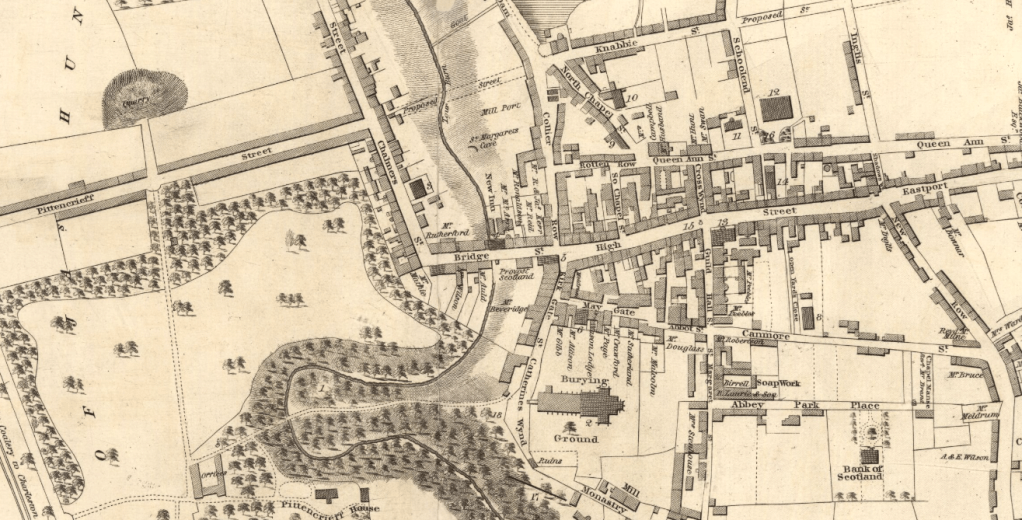
The church that James and Isobel were married, in 1795, was build near Queen Anne Street which is under the current Kingsgate shopping centre in Dunfermline. If have have any knowledge of Dunfermline you will see notice a lot of similarities to now on the map below. This map is from late 1700/early 1800. Bridge Street is the most unchanged from this period of time. Interestingly the parish population of Fife in 1755 was 81,570 (In 2022 it was 374,730). Aberdour 1198, Beath 1099, Dalgetty 761, Dunfermline 8552 people.
11th Generation – Androw Lietch* and Margaret Hume.
The birth certificate for Androw Leitch is very difficult to read – mainly because of the language difference in 300 years! His parents were Andrew Leitch and Isobel Bennittie and he was baptised 20th January 1715 in Aberdour.

There was a lot of political and religious upheaval during this time period. Government troops were stationed at Aberdour Castle during the Jacobite Rising of 1715. During their stay a fire caused extensive damage. In 1725, the Mortons bought an adjacent property, Cuttlehill House, which they renamed Aberdour House, and the castle ceased to be a residence. The east range was again repaired, and was used for various purposes, including a school room, a barracks, and a masonic hall. In 1924 the castle and gardens were placed in state care, and continue to be managed by Historic Environment Scotland as a visitor attraction.
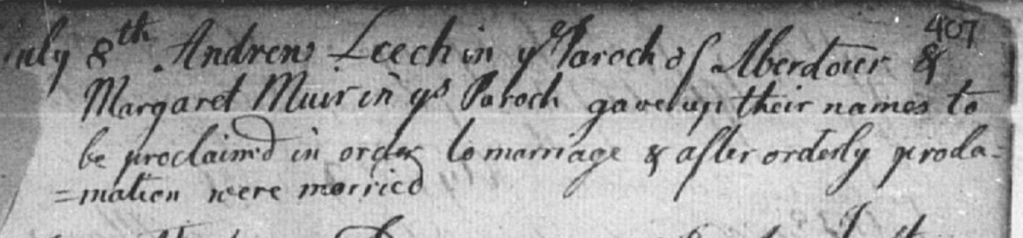
By the time Andrew married Margaret’s Hume on 8th July 1737 they were part of the associate congregation – this could very well be a direct link to the Jacobite Rising as i found the following passage “In the early 1700s a dispute over the occupancy of the ministry arose on the death of the incumbent when the Earl of Morton imposed his choice against the wishes of the population. The result was the mass exodus of the congregation to neighbouring parish churches”
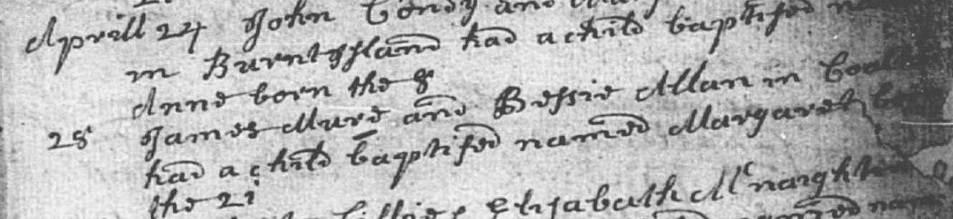
Andrew’s wife Margaret was born in Dalgetty on 21st April 1717 to James Muir & Elizabeth Allen. Dalgetty is only 2 miles along the coast from Aberdour. Records show that she gave birth to at least 15 children and died aged 52 years.
Dalgetty has it’s own rather gruesome history which is depicted in the Scottish Ballad “The Bonnie Earl O’ Moray” (giving us a snapshot of the music of this era) . The land surrounding the town of Dalgetty was part of the estate owned by the Earls of Moray who built Donibristle House as their residence. In 1592 James Stewart, 2nd Earl of Moray was murdered on the seashore near Donibristle by his rival George Gordon, Earl of Huntly, which is remembered in this popular ballad Towards the end of the 18th century, the village was destroyed by order of the Earls of Moray and the inhabitants dispersed.
12th Generation – Andrew Michie Lich* & Isabel Ballentine

Andrew Lich was baptised on Sunday 2nd March 1679 in Wemyss! The family had moved around the coast. The words of King James VI of Scotland when describing Fife rings true in this family “a beggar’s mantle with a golden fringe”. Due to the prosperity of the coastal burghs from St Andrews in the east to Kirkcaldy and Dunfermline in the west, with several important fishing villages lying in between people moved around the edge/fringe of Fife.
This also shows a true circle of life when my Di lived his whole life just along the road in Methil – and one of his first jobs was in the Wemyss!! I guarantee he had no idea his family had walked the same path many hundreds of year ago, and so many reading this will also have walked those very paths.
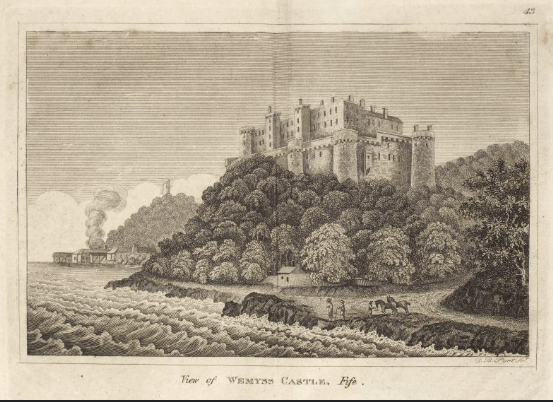
The name Wemyss is from the Scottish Gaelic “Uaimheis” meaning ‘Cave Place’. The parish gives its name to the family and Earls of Wemyss. Accounts show that construction of Wemyss Castle begun in 1421. Historically, the castle is perhaps best known as the location where Mary, Queen of Scots, met her future husband Lord Darnley, on 17 February 1565. There is also records of the King requesting the Earl of Wemyss to keep prisoners for him in Wemyss Castle.
Almost a dozen towns and villages have existed in Wemyss parish over the years, some now joined to form larger settlements: Buckhaven, Denbeath, East Coaltown, East Wemyss, Kirkland, Innerleven, Methil, Methilhill, Muiredge, West Coaltown and West Wemyss. Coal mining was once the principal industry of the district, the coal being exported from the port of Methil. Its harbour was constructed by David, 2nd earl of Wemyss, and the town was a burgh of barony in 1662. My family history has direct links for 1662 to the end of the coal mining industry in the 1980s.
Andrew married Isabel Ballontino on 6th April 1706 in Aberdour. Isobel was born in Kemback, Fife in 1692. She married at 14 – this is not usual for the time. Records show she died in Aberdour in 1744.

13th Generation – James Leitche* & Christian Michie
James Leitche was born in Dairsie, Fife in February 1650 to David Leitch, they didn’t even bother to enter the mother’s name on birth certificates back then! James had an older brother David who was born 3 years previous in 1647 – nope no mother registered on his birth record either! luckily with some further research I was able to find a Mother’s name as James parents were married in St Andrews. Dairsie is a small village and in 2011 the civil parish has a population of 387.


With a population so small even now it is hard to decipher why they were living in Dairsie, I believe that Dairsie Castle is the link. Dairsie castle was rebuilt in the 16th century by the Learmonth family. In the 17th century it was sold to John Spottiswoode (1565–1639), Archbishop of St Andrews….where James parents were from. The link to the castle could be why the family moved to another castle – Wemyss!
James move to Wemyss at some point before 1678 where married Christian Michie on 3rd August. Only half the record below is legible.
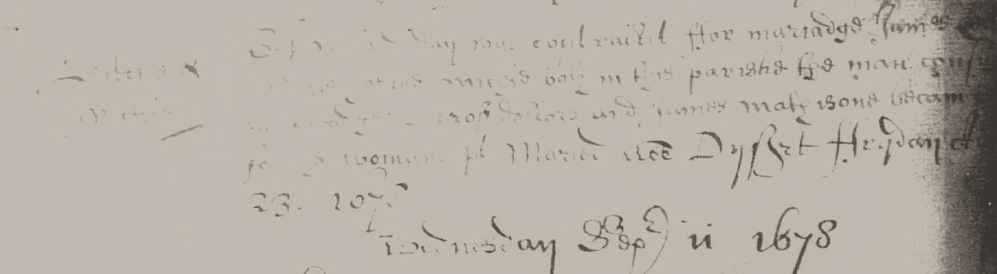
14th Generation – David Leitch & Elspet Davidsone
Records are becoming increasingly hard to find, however I have been able to find the marriage certificate of David & Elspet . They were married in St Andrews and St Leonard, Fife in 31st July 1639.

David and Elspet had 5 children before moving to Dairsie where my ancestor James was born, luckily the mother’s name was taken in St Andrews

To have records so far back it does make you wonder, these are not simple peasant’s. Peasant’s did not have thorough records kept, the odd one yes but I have found some for every generation in various areas of Fife. I believe they were educated people who moved to where the church and the crown ( or at least the Earl) needed them. Maybe a tutor, a horseman, butler, never a farmer for the laird but a connection is there somewhere. I could romanticise it more but I’ll keep to the facts.
Before I update the final generation I have covered I wanted to remind you that I have only concentrated on the parental line. Each and every one of their wives have their own story to tell (Just like I am telling you mine!). The snippet of information I will share is the Beveridge line – yes way back to Jannet Beveridge.
Jannet’s family stayed in Dunfermline/Aberdour area through the generations all the way back to the 14th Generation. Thomas Beveridge (Belfrage) who died in 1675 and is buried at St Finian’s in Aberdour. Probate records show he was a flesher!
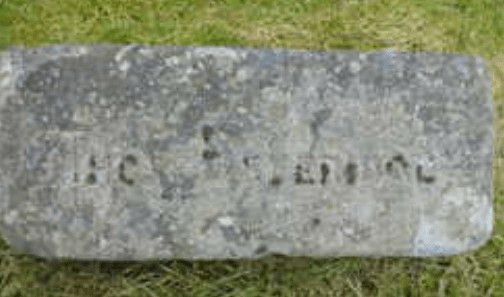
A flesher was the old Scots name for a butcher, but one who undertook a wider range of tasks associated with their trade than present practitioners would. St Finian’s is a beautiful ruin and a much loved walk of mine. I do love to be by the sea and when I have 500 years of ancestors who lived next to the water I now know why! Below is one of my many picture of St Finian’s – I took this on Saturday morning!
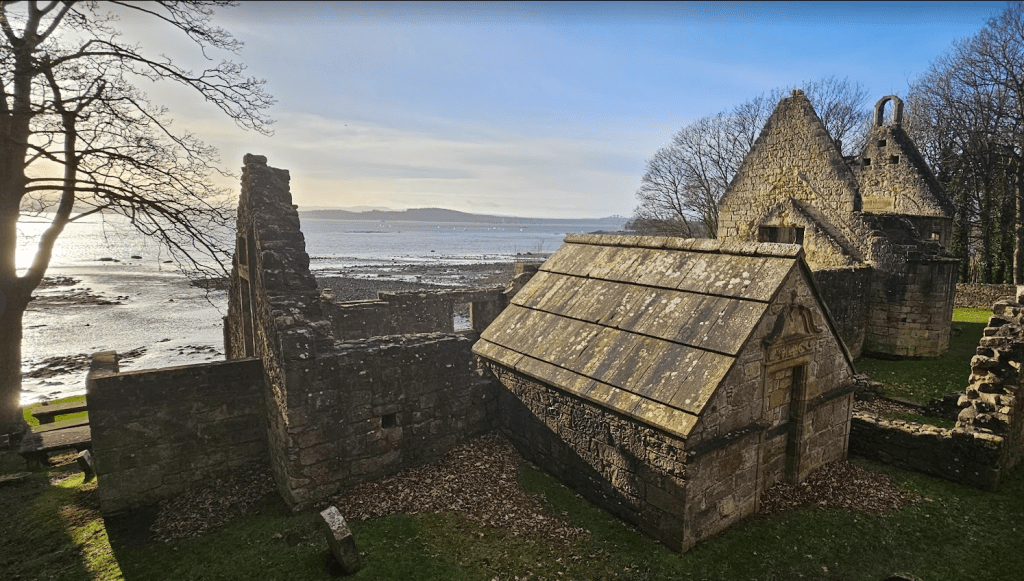
15th Generation – Reverend David N Leitch
My final instalment is that of Reverand David Leitch, he married Pauline Sommer. However the information I am sharing with you is not of birth and marriage records but research of his work I have found online. I have copied straight across as this is not my work.
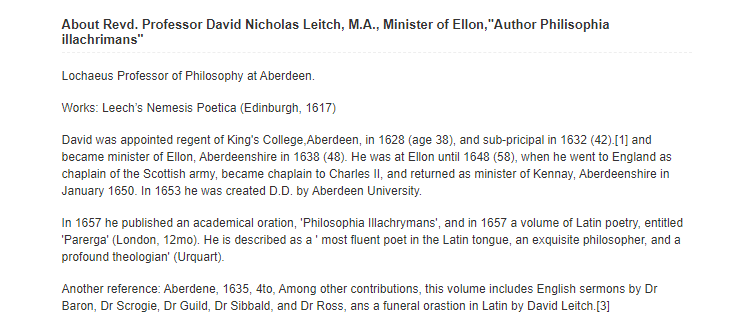
I believe he was born in 1590 Maryton, Angus, Tayside and thus the further back in the story we go could maybe take us out of Fife.
 Marie's Genealogy