5th Great Grandmother
9th Generation
Born - 2 March 1819 - Glasgow, Scotland
Died - 29th July 1873, Bridgeton, Glasgow
Margaret was born in Glasgow on 2nd March 1819 to George William Colville and Ann Ralph. George was a bookbinder. Bookbinders turn printed paper into books and catalogues by hand or using machines. Vellum and leather had been the traditional binding materials for centuries and they continued to be used throughout the 1800s but animal skins were costly and stocks were limited. To meet commercial demand now that more of the population were abel to read, binders needed a covering that was cheaper, more widely available and quick to produce. These are the type of jobs that give an insight to a different world.

Margaret married her first husband James Madden in 1836 and married her second husband, James Rattray in 1868.
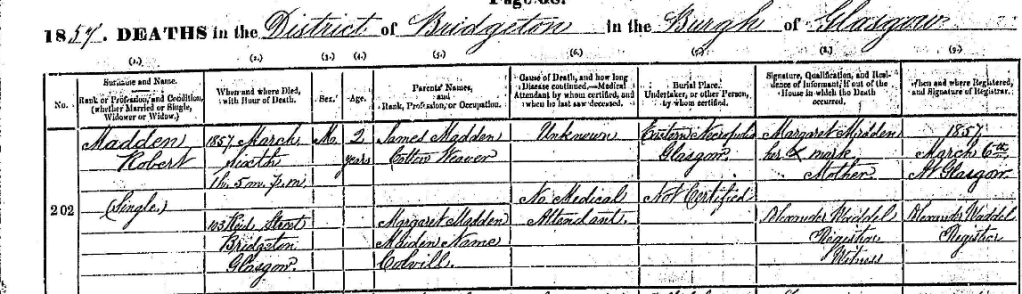
Margaret and James Madden had at least 5 children together with at least 3 living past infancy and staying in local areas. It is unclear when Margaret’s first husband died however it must have been after 1855 as they had a son then, sadly he died in infancy with the cause of death unknown. It is unusual for the mother to sign the birth certificate so he may have died whilst she was pregnant or being too sick to register the birth.
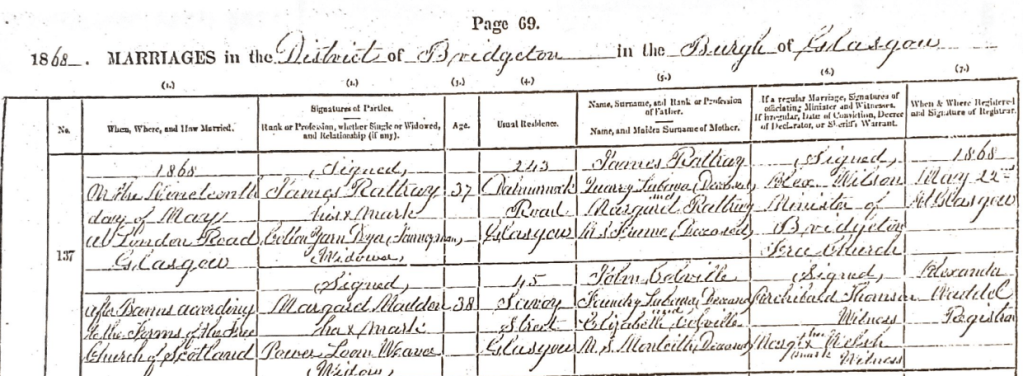
You will note that not all the details match up between Margaret’s marriages. Margaret was born in 1819 therefore she would be 49 not 38 when remarried and her mother’s name was Ann Ralph not Elizabeth Monkeith. However I am confident that this is the same women as her maiden name, married name and area are all a match. It may have been that her mother died young and she was brought up by Elizabeth.
Margaret was living with her first husband in the 1841 & 1851 census but she was head of the house in 1861 working as a Power Loom Weaver
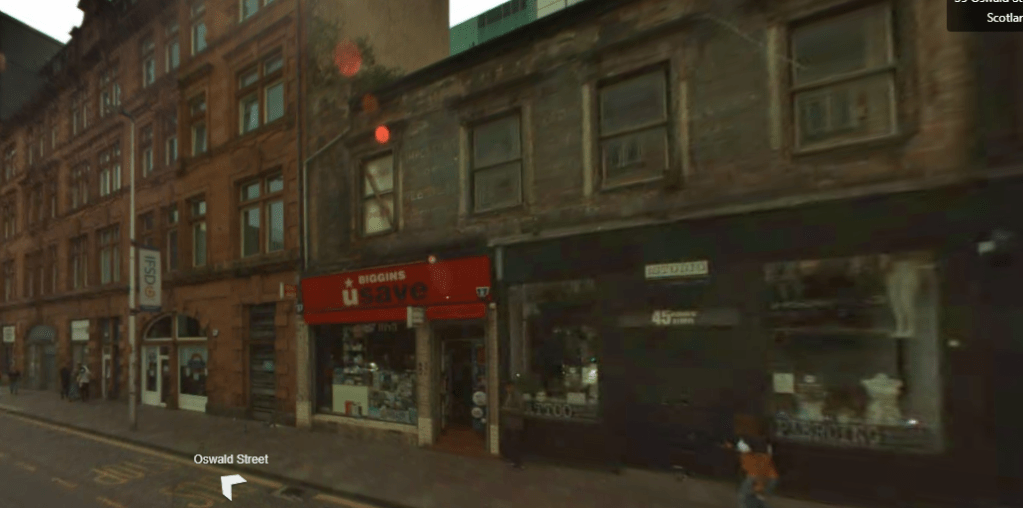
This is a google maps image of Oswald St today, although many of the buildings have changed these ones could be the very same as what Margaret lived in. On of the greatest changes since then is Central Station which was build in 1879, only a few years after she died.
This paragraph below I have taken from online as it very much shows Margaret’s life as a weaver.
During the period between 1760 and 1830 the Lowland Clearances reduced demand for farm labour, forcing families to the cities to find work, usually in the mills. Life was hard; poverty, disease and desperation were rife. The displaced cottars had few skills other than weaving. They crowded the mills depressing wages. The end of the Napoleonic wars in 1815 released soldiers into the workforce, increasing the problem.[14] Irish immigrants also swelled the working population. By 1851, 23% of the population of Glasgow was Irish in origin. The Irish were blamed for crime and unemployment but, evidence of the time showed that, in fact, the Irish were more willing to work and less likely to seek relief than the Scots.
From the later part of the 18th century, and accelerating in the 19th century, the weaving industry became increasingly mechanized. The flying shuttle halved the time to weave a piece, although it was not introduced to Scotland until the end of the 18th century. Steam-powered spinning mills were built starting in 1798. Power looms were used in Scottish linen weaving as early as 1810.[18] Population growth and industrial mechanization combined to cause increasing social problems.
Margaret’s correct age and details are also confirmed with the death certificate as she was 55 when she died only 5 years after she remarried. She didn’t get many years with her second husband.
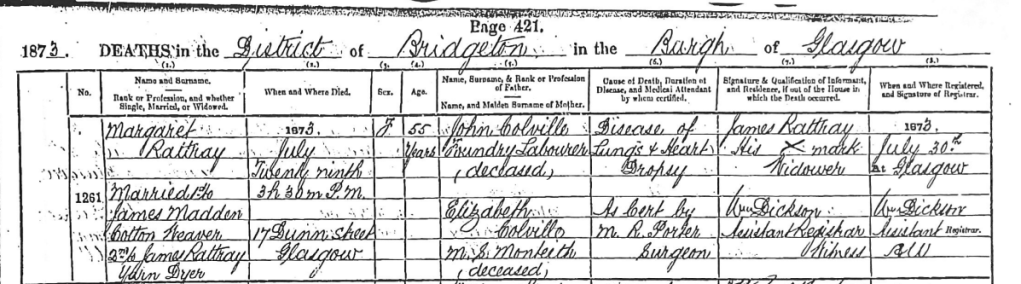
These certificates show how inaccurate records can be and why I find it important to have at least 2 separate records to confirm someone’s identity. Something that is getting increasingly difficult as I research further back.
Husband – James Madden
Daughter – Elizabeth Madden
 Marie's Genealogy