5th Great Grandfather
9th Generation
Beattie is a surname of Scottish and Irish origin. In some cases from Bartholomew, which was often shortened to Bate or Baty. Male descendants were then often called Beatty, or similar derivations like Beattie or Beatey. The name Beatty or Beattie, others think, arose in Ireland from Betagh, a surname meaning hospitaller. The majority of people named Beatty or Beattie in Ireland are the descendants of Scots who came over to Ulster in the seventeenth century. Beattie is common in counties Antrim and Down, whilst Beatty is more common in counties Armagh and Tyrone.
I have no birth, marriage or death record for Robert Beattie. However, the records we have from his wife and children confirm he was a joiner / wood Sawyer that lived in Newtownards, County Down.
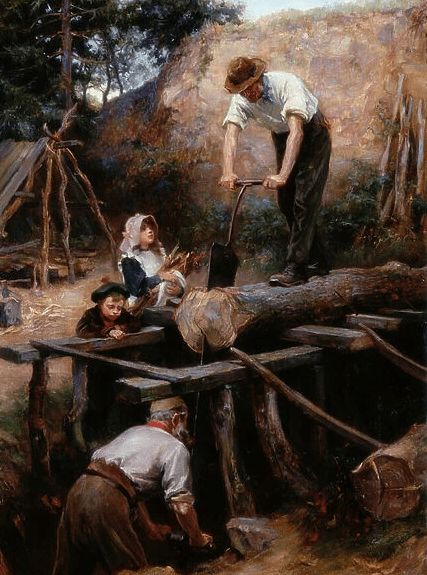
Sawyer: an occupation, one who has the tools & knowledge to accurately
saw wood, and especially , make veneers of all kinds for use by furniture. & cabinet makers, e.g. “As a sawyer, he bought raw lumber from the sawmills and sold the finished product to the cabinetmakers.
I also know from Robert’s children’s birth certificates that he was a Presbyterian. The history of Presbyterianism in Ireland can be traced back to 1613. The first Non-Subscribing Presbytery was formed in 1725 and our most notable historical leader, Dr Henry Montgomery, took a leading part in the controversy in the 1820s that led to the formation of the Non-Subscribing Remonstrant Synod of Ulster. “Our Church refuses to impose compulsory subscription to any man-made creeds in respect of a person’s Christian faith”. Our ethos is ‘faith guided by reason and conscience’ and we advocate liberal and tolerant Christianity.
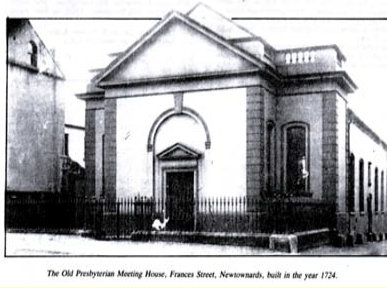
A congregation of Presbyterians emerged in Newtownards when the Earl of Eglinton’s Regiment was stationed in town in 1642. A low, thatched meeting house was erected in 1670 . The old meeting house was replaced in 1720 when Rev. John Mairs (1706-1718) was preacher.
The church was rebuilt in 1815 in Frances Street after a split with New Light sect. The costs involved were £3,000 which was paid for by the congregation. Attendance was on average 700-100 people. It was described in 1836 as extremely large & plain with an average attendance of 800 people.
I know that Robert’s wife Jane Ellen was a widow when she arrived in Scotland in 1861. Church records show that a Robert Beattie died in Knockbreda, Ballylenaghan on 14 Nov 1859 aged 56 and is buried in Knockbreckan Reformed Presbyterian graveyard. Dates, ages and location all match however I have no confirmation if this is correct Robert Beattie.
Wife – Jane Ellen Strickland
Son – William Beattie
 Marie's Genealogy