5th Great Grandmother
9th Generation
Born -Approx 1811, Derry, Ireland

Died - 22 April 1883, Maud Poorhouse, New Deer, Aberdeen
Mary was born in Derry, Northern Ireland. I have no records of her in Ireland, this may because the name Haggerty is the shortened Anglicized form of Gaelic Ó hÉigceartaigh, also Ó hÉigeartaigh, ‘descendant of Éigceartach’. Making it difficult to trace back. However census records confirm she came from Derry. Records also show that many Haggerty’s from Derry, went to America at the beginning on the 1800’s.
The first record I have for Mary is in Scotland, in the 1861 census. She is 50 years old and living as a lodger in Shuttle Street, Aberdeen. (We already know this is a poverty stricken area with high crime rates). We also know her husband died this very year in the poor house.
We know that Mary lived through the potato famine and her husband joined the British military (not a popular choice in Ireland) whilst she was in her 20s and 30s. As she approached later life it didn’t get any easier. She moved out of the city to Alford, Aberdeenshire but she is stated on the 1871 census as a Vagrant – a person without a settled home or regular work who wanders from place to place and lives by begging.
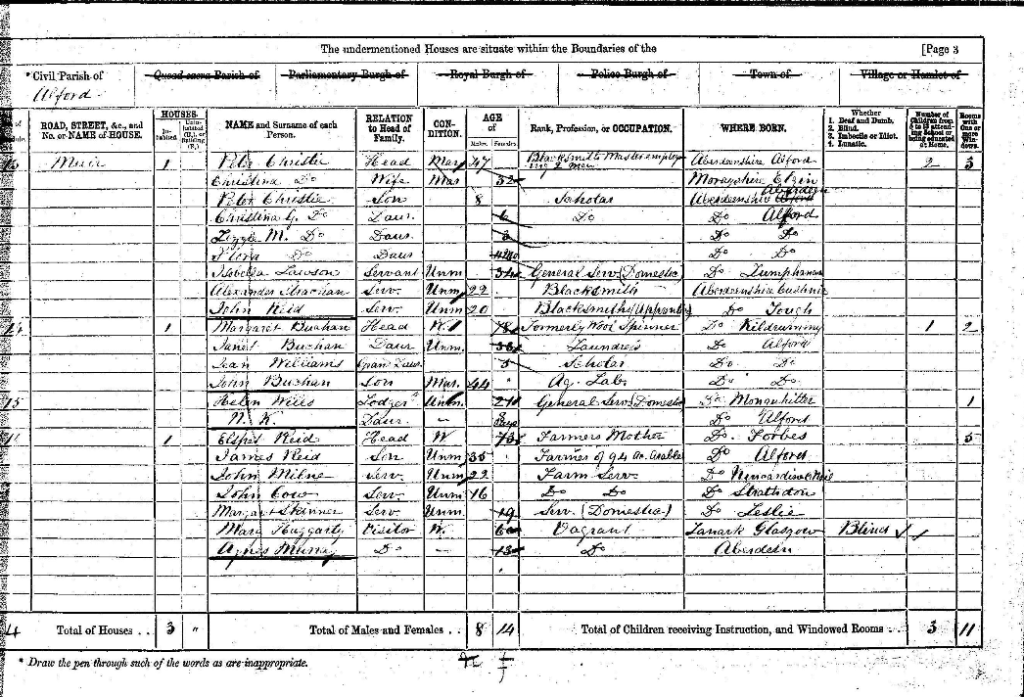
It also notes her a Blind, this could be hereditary or age related as her daughter is also registered as blind later in life. This is a world without healthcare and little to no help for degenerative conditions for the aging population.
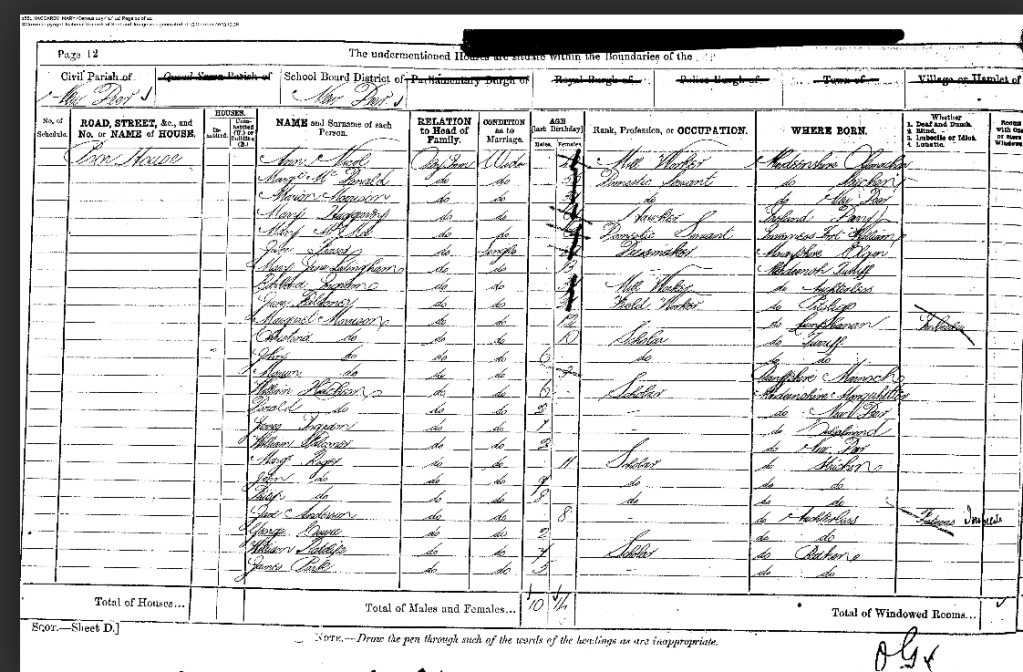
By the next census in 1881 Mary has reached 70 and is in the Poor House at New Deer, Aberdeen. Interesting it states her occupation as a Hawker. Her husband also had an occupation as a Hawker on some of the records, this will be due to the travelling around as a hawker is a person who travels from place-to-place selling goods.
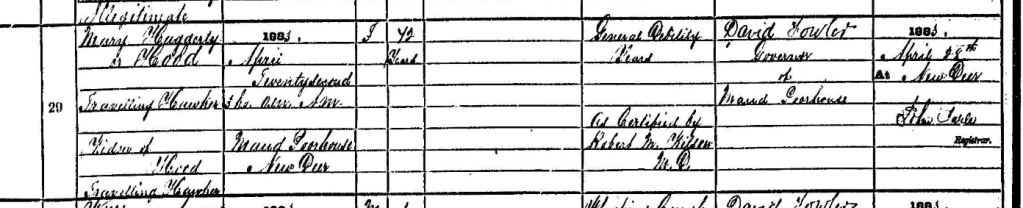
Sadly no family signed her death certificate. Her death certificate also confirms that although they knew her married name was Flood they did not know who her husband’s name. He had died some 20 years earlier. Her daughter Mary was also living in New Deer, Aberdeen so therefore family were living close by but due to the work house rules it’s impossible to know if they were in contact.
A little history of the Maud Poorhouse
Under the Poor Law Amendment (Scotland) Act, 1845, the Church was relieved of its duties in the field of poor relief. Parochial Boards were established to administer the poor law, with powers to combine with other boards to erect a poorhouse. The combination formed in Buchan originally comprised sixteen parochial boards – Fraserburgh, Strichen, New Deer, Tyrie, Pitsligo, Rathen, Lonmay, Cruden, Ellon, Methlick, Old Deer, Tarves, Udny, Logie-Buchan, Longside and Monquhitter. Under a Deed of Constitution in May 1866 they joined forces to erect a poorhouse. They decided to place it in Maud because of its central position in the district and, as it was a railway junction, easily accessible.
This poorhouse was seldom fully occupied. Thus, during the First World War, when the poorhouse was asked to receive a number of inmates from Aberdeen’s Oldmill poorhouse, which had requisitioned as a military hospital, space room was readily found for more than 20 additional inmates. When the National Health Service was set up in 1948, the Buchan Combination Home was one of several former poorhouses that were transferred to the new service, largely because the majority of its inmates were then classified as ‘sick’. The Home was re-named Maud Hospital in 1950 and cared mainly for geriatric patients. It closed in October 2008.
Unfortunately, like her husband, no parents details are available and I am unable to take this branch of my family any further back.
Husband – James Flood
Daughter – Mary Flood
 Marie's Genealogy