5th Great Grandmother
9th Generation
Born - 12 September 1809 - Halbeath, Fife, Scotland
Died - 5 February 1834 - Halbeath Fife, Scotland
Annie was born to James Smith and Margaret Bowman in 1809,
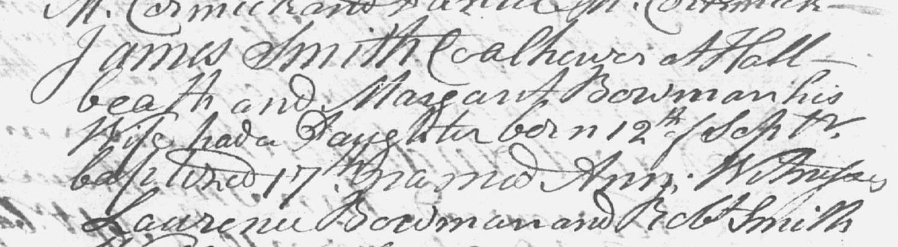
It’s difficult to find records of some women, I thought this extract of a life / marriage from Halbeath in the mid 1800’s will give us a glimpse of this woman’s life.
There is perhaps no hamlet in the county which clings more firmly to old customs than Halbeath. The village consists of the “Long Row”, as it is called, and a series of red-roofed short rows. People who want to study the manners and customs and activities of village life must go to the “Long Row”, which sits on the crest of a ridge on which the “Queen” pit was sunk shortly after the crowning of Queen Victoria. I can remember the time when the whole of the output of this great pit, which was one of the pits under the charge of Mr Charles Carlow’s late father, was drawn in waggons by horses to the Ness beyond Inverkething, a distance of four miles, and from the little port was shipped to the Baltic and other parts. In the busy summer shipping season the villagers were kept awake at night by the “roar” of rumbling waggons, the clatter of horses’ hooves, and the crack of the driver’s whip.
Even at busy times there was now and again a suspension of labour, and young and old congregated in the “Long Row”. While the older men leant on the palings and water barrels in front of the houses, and the young lingered round a certain doorway, all suddenly became excitement, and out came a marriage party. The bridesmaid hanging on the arm of the bridegroom. The bride and “best man” formed the second couple, and then came the innumerable couples who had been invited to the wedding. In fair or foul weather the company marched in procession order to Crossgates or to Dunfermline, one and a half or three miles, to a manse where the knot was tied. Headed by “Jude” the village fiddler, the marriage company trudged home in procession order. “Jude” played his merriest of tunes, and when passing Water Head or the Ha’ on the way from Crossgates, the company had to run the gauntlet of a fusillade of old “bauchels” or some kind of cast off shoe leather. In the return journey the bridegroom and bride led the way, the best man and bridesmaid being relegated to second position and at the “Plantin’” near the top of the “’Cline brae” the wedding party were met by the whole village, and three pistols were fired, “peeoys” set off, and aprons, which did duty as banners, unfurled.
The marriage feast was invariably set in the house of the newly married pair and as the bride entered her “ain hoose” her mother-in-law broke a cake of shortbread over her head. The broken cake was held to be a perquisite of the children who surrounded the doorway. If the men hung about long enough they had their patience rewarded sometimes through the good offices of the “best man” with a “wee drop” to keep the cold out. The height of ambition of the bride of these days was a black silk gown, a Paisley plaid and a white bonnet and the plainness of the skirt of the gowns was made up by the width necessitated by crinolines”.
How different life was then, how different marriage was then. Annie gave birth to 3 children. Margaret, my ancestor in 1827, Alexander who followed his fathers footsteps and became a Collier and Catherine. Unfortunately Catherine died of weakness at only 5 weeks old (death record below).

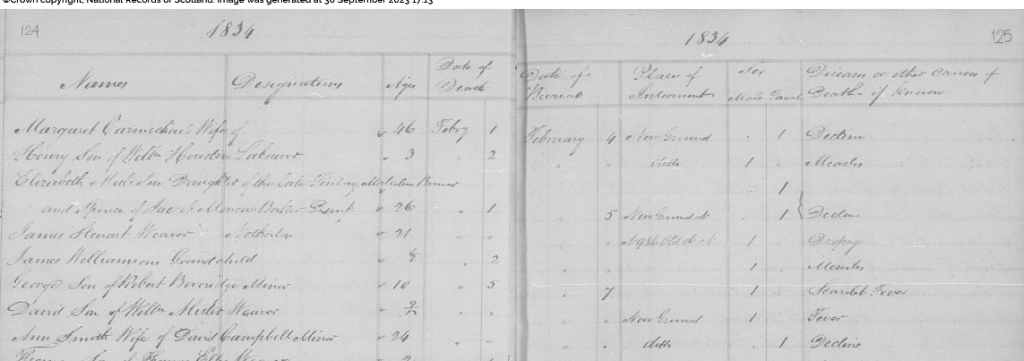
What follows is the last record record I have of Annie, her own death record some 11 days later. Annie was only 24 years old and the record states cause of death as “Decline”, she had only given birth 7 weeks earlier. Statistics how this happened often in the 1800s however it makes all more real when it’s your ancestor.
Daughter – Margaret Campbell
Husband – David Campbell
 Marie's Genealogy