4th Great Grandfather
8th Generation
Born - 1832 - Newtownards, Northern Ireland
Died - 11 July 1893, Gallowgate, Glasgow
William was born in Newtownards, Ireland to Robert Beatty and Jane Ellen Strickland in 1832. Newtownards is a large town in County Down. It stands at the most northern tip of Strangford Lough, 10 miles east of Belfast, on the Ards Peninsula. The town is known by locals as “Ards”.
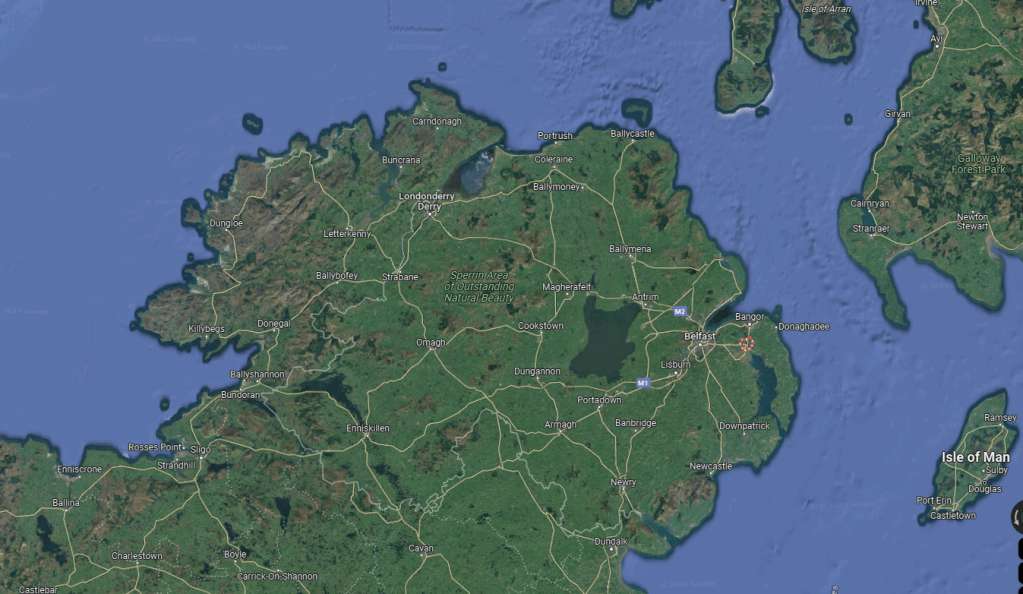
William and his family lived through the Great Famine. In County Down the largest local landowner, Lord Londonderry, rejected rent reductions on grounds of “personal inconvenience”. By 1847 the 800 inhabitants of the town were witness to “emaciated and half-famished souls” queuing at soup kitchens and overflowing the newly built workhouse. Despite Lord Londonderry’s objection, with the upgrading of the road to Donaghadee several public works programs for famine relief were instigated. In general, conditions on the land, not as acutely subdivided as in western districts of Ireland, and the availability of weaving and other employments, saved the town from the worst. William became a weaver.
In the 1830’s Great Britain and Ireland had 3 monarchs – George IV, the former Prince Regent, who died in 1830; his brother, William IV, known as the Sailor King because he had been Lord High Admiral; and their niece, Victoria, who became Queen on William’s death in 1837 at the tender age of 18. When Queen Victoria ascended the throne Trafalgar and Waterloo were fading memories, as was the summer of 1798 when the men of Antrim and Down took up arms against the British Crown. Britain also took Hong Kong from China and Inventions were rapidly changing the world in fields such as electricity and photography. The first passenger railway ran between Liverpool and Manchester and we had the first regular transatlantic steamship service. Charles Darwin set sail in the Beagle, Charles Dickens wrote Oliver Twist and the first Grand National took place!
William had 3 siblings – George born in 1837, Elizabeth 1839 and John born in 1844. The story states that George was born in a boat between Scotland and Ireland (I haven’t found the birth certificate to confirm this)! It was however common practice for men to go between Scotland and Ireland for seasonal work with their families. After the famine the family came over to Scotland and stayed.
His brother George married in Scotland and had his children before emigrating in 1902 to Saskatchewan in Canada. All of his children also emigrated. Most of them stayed in Canada however a few travelled south to America to start their new lives. Records indicate that his sister, Elizabeth also emigrated to Canada.
William’s brother John joined the British Army as an engineer, he married and had 8 children of his own. His military career was mostly based in south England and he lived his later years in Falmouth, Cornwall – living until 78 years old. An immense achievement for someone born during the famine.
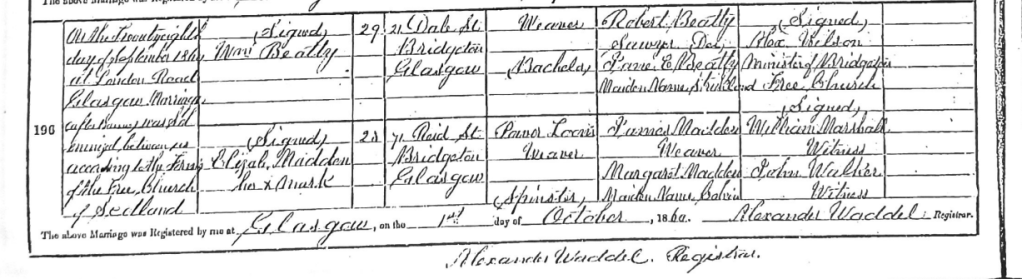
The first record I have for William in Scotland is his marriage record in 1860. He was 29 years old when we married Elizabeth Madden and had already lost his father as well as many other through the famine. His occupation is a weaver and his wife a hand loom weaver.
The mills brought all the processes of spinning and weaving under one roof, and with the use of machines, sped up production. This meant that mill made cloth was cheaper to produce than that made by cottage industries.
By 1871 they were living at 138 King St, Glasgow and William was now a Carter, A Carter in the Cotton Industry would be seen as a huge step up from a Weaver as the manual labour was less.
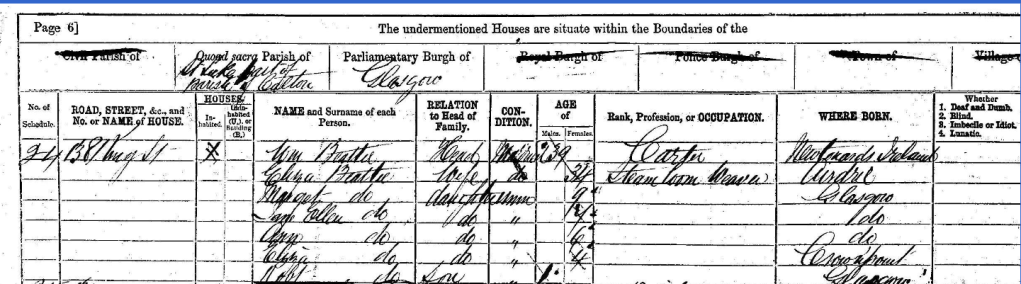
In 1881 William was 49 years old and still had 4 daughter and 2 young sons living at home – Jane 17, Ann 16, Elizabeth 13, Mary 9, Hunter 4 and Robert 3 years old. His older children were also having children on their own! He had done the same as many of my ancestor’s by renaming younger siblings after an older sibling had died.
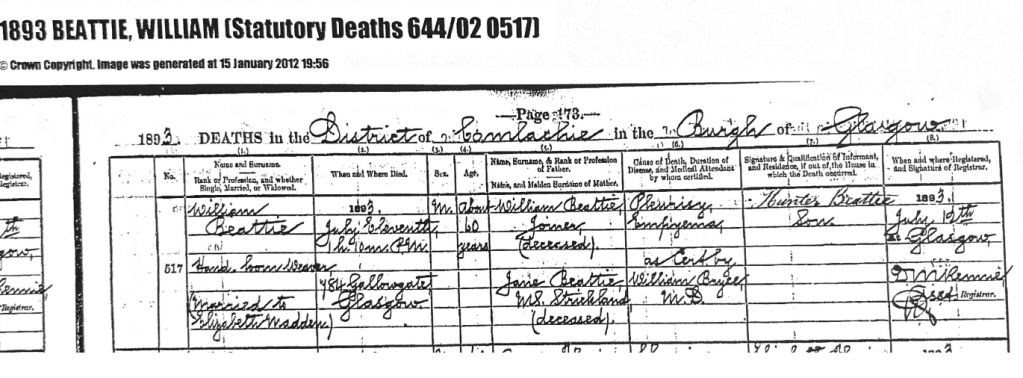
Unfortunately I can’t find the census record for William in 1891 and in 1893 he died of pleurisy. Pleurisy is inflammation of the sheet-like layers that cover the lungs (the pleura). The most common symptom of pleurisy is a sharp chest pain when breathing deeply. In most cases are the result of a viral infection (such as the flu) or a bacterial infection (such as pneumonia).
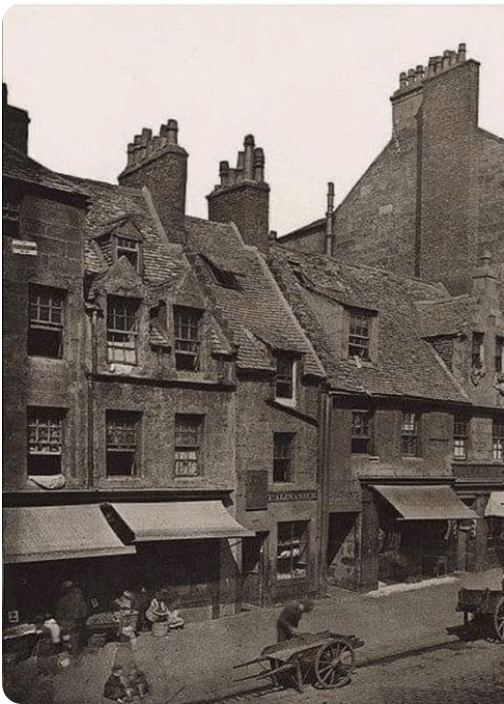
This is a picture taken in Gallowgate in the 1890’s around the time William lived there.
The history is that criminals were taken along Gallowgate to the gallows on the Town Moor near Fenham Barracks, where between 1650 and 1829 44 people were executed.
Daughter – Margaret Beattie
Wife – Elizabeth Madden
 Marie's Genealogy