4th Great Grandmother
8th Generation
Born - Abt 1827 - Dunfermline, Fife, Scotland
Died - 10 February 1903 - Cowdenbeath, Fife, Scotland
Margaret’s parents, David Campbell and Annie Smith were married in 1826. Margaret was born around 1827, a younger brother Alexander followed who was born in 1829. Their mother Annie died in 1834, when Margaret was only 7 years old. Their father died 5 years later. Leaving Margaret and Alexander Orphans at 12 and 10 years old.
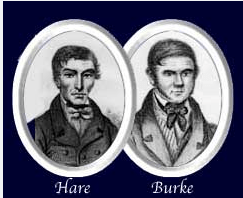
It is alleged that the infamous graverobbers Burke and Hare sourced some of their cadavers from Beath Cemetery, to supply to the Scottish surgeon Robert Knox for dissection. Although we all know about the infamous graverobbers – it must have been scary to live in the same time as this was happening. Margaret was born the year Burke and Hare came over from Ireland and her parents died whilst she was young so it would have been very real for her as Beath was the neighbouring area.
In 1841 Margaret and her brother are living with Andrew (40) and Eleanor Campbell (70), unfortunately we do not know their relationship to them or to each other as this information was not collected back then. It does however show that Alexander is already working as a coalminer.
Whether or not they would have been aware that Queen Victoria stopped at the Cowdenbeath Coaching Inn to change horses on her first trip to Scotland in 1842 is questionable. The coaching inn, the Old Inn, was established at the junction of roads from North Queensferry, Perth, Dunfermline and Burntisland. Therefore fesiable to have actually seen her.
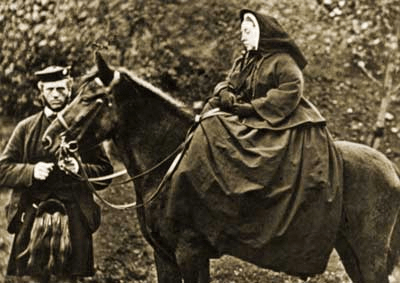
The second visit of a United Kingdom monarch to Scotland was in 1842 when Queen Victoria and Prince Albert disembarked at Leith.
Their explorationwas so pleasurable that they returned to Scotland annually and in 1852 they bought Balmoral and had the castle built.
By the 1851 census Margaret had married James Rattray and was living in Crossgates, near Beath. She stayed in Crossgates for what looks to be over 20 years before the family moved back to Dunfermline. They moved to Townhill this time which was largely a coalmining area. In this 20 year time span Margaret had 10 children, her youngest, Johan was only 7 months old in 1871. This shows us that Margaret was still having children in her 40s.
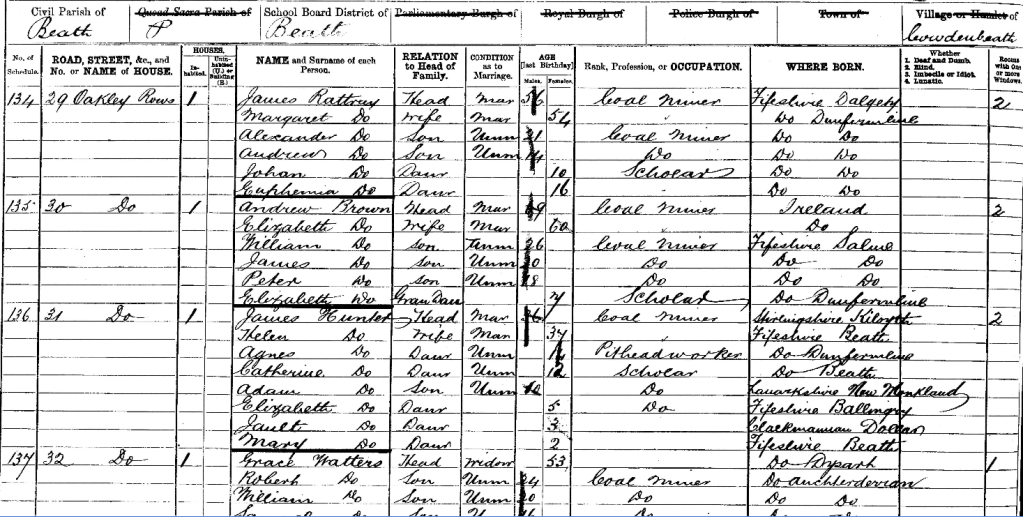
The census below is a snap shot of 1881 and the family now living in Cowdenbeath.
Before the 1850’s Cowdenbeath was just a collection of farms within the parish of Beath. Local inhabitants of the focal points of growth, which were merging into a single town, met to decide on a name for the emerging town. The eventual decision was narrowed down to either White Threshes or Cowdenbeath and Cowdenbeath was the chosen name. The arrival of the Oakley Iron Company shortly afterwards was to have a long-lasting impact upon Cowdenbeath and make the name synonymous with coal mining for almost 100 years.
This will be why come the 1881 cenus the family had moved to Cowdenbeath and were living at 29 Oakley Rows, she was 54 – her son was 14 and a coalminer! Coalmining was all she ever knew. Oakley Rows mostly belonged to a gentleman named Halley, which was responsible for the street being originally called Halley’s Row. Everyone that lived there was a coalminer.
Margaret lost her husband in 1882 and the next record we have in 1891 she was living in Thistle Street (Also in Cowdenbeath) with her youngest daughter and her husband and baby. This record shows as Margaret being a former servant indicating that she had worked. As she had a lot of children I would be inclined to believe that this was after her Husband died.
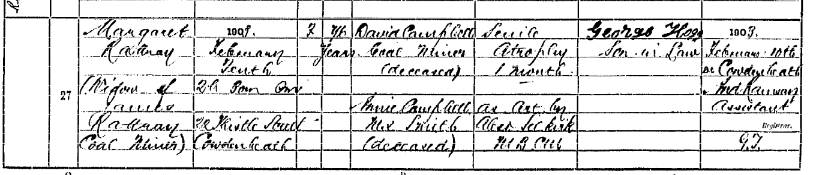
In 1901, 10 years later, Margaret is still living with Johan and her family – Johan had 5 children by now and 2 years later when Margaret passed the cause of death was senile atrophy (wasting of tissues and organs with advancing age from decreased catabolic or anabolic processes, at times due to endocrine changes, decreased use, or ischemia). This must have been really hard for her youngest daughter to take care of her whilst bringing up a young family.
Cowdenbeath was becoming more prosperous. Much of this increased prosperity was due to the Franco-Prussian War, which brought about a great demand for coal. Cowdenbeath lined very important main roadways. Vacant spaces in High Street began to be filled up and extra houses were built in Union Street (Gardiner’s Land) and Halley’s Row (mentioned above). By 1870, Cowdenbeath had begun to be recognised as a centre, but it was a long time before the inhabitants got over the habit of looking upon Dunfermline as their shopping centre. Every Saturday the wives used to go to the Old Station and ask for ” a ticket for the toon,” and the clerk knew well that ” toon ” meant
Dunfermline. Shops, however, started to spring up, mostly owned by natives
of the village.
Father – David Campbell
Mother – Annie Smith
Husband – James Rattray
Daughter – Ann Rattray
 Marie's Genealogy